Latest NCM-MCI Exam Format, New NCM-MCI Test Labs
Wiki Article
P.S. Free 2026 Nutanix NCM-MCI dumps are available on Google Drive shared by Pass4training: https://drive.google.com/open?id=1t_1IZNDXR_tcVzmiPBwoC1imzKdPVywU
Normally IT workers have two purposes to test for certification: one is just for certification as of job demand; two is setting one goal for striving. Why do you try our NCM-MCI new exam guide materials? Our products are valid tested by more than 6000 candidates and can help you clear exam certainly. Forget your puzzled and distressed mood, choosing our Nutanix NCM-MCI new exam guide materials will help you success without any doubt.
What is the salary of the Nutanix NCM-MCI Exam
The Average salary of different countries of Nutanix Certified Expert
UK - Pounds 45,280 per year
United States - USD 116,178 per year
India - INR 776,970 per year
The need for Nutanix NCM-MCI Exam study material
Nutanix NCM-MCI exam is a technical exam. This test requires candidates to have a clear understanding of the architecture and features that are associated with the Nutanix Prism web console and Prism Central. The topics covered in this exam are Networking, Storage, Security, and Cluster Management.
Candidates who plan on taking the Nutanix Certified Master - Multicloud Infrastructure (NCM-MCI) Exam (NCM-MCI) exam are required to take a training course so that they can acquire enough knowledge and skills to copyright in one go. If you wish to know more about the training course then you should visit the official website of Nutanix. You will find all the information related to training and certification exams on this site.
Nutanix NCM-MCI Dumps has been a great help for all the IT students. Most of the students have passed their Nutanix Certified Master - Multicloud Infrastructure exam with the help of certification questions. It has become possible due to the ease and accessibility of exam dumps material. These practice test are not only just for passing exams but also for improving skills and having expertise in relevant field. You can have online practice test and see your results yourself. You will be able to know where you are good at and at which points you need to focus more. In this way, you will learn accordingly and will get rid of your weak points. It is a short path to success that can take you to places within no time.
We offer free content demo actual prep tests version. We guarantee of dedicated qualification of sites for administrator receives container objectives.
>> Latest NCM-MCI Exam Format <<
New NCM-MCI Test Labs - New NCM-MCI Dumps
If you want to get something done, just roll up your sleeves and do it. If you want to clear NCM-MCI exam, let our training online files help you. The more difficult the thing is the more important and useful it is. Nutanix NCM-MCI training online files help your difficult thing become simple. Professionals be professionals! People can be defeated, but can't be beat. If you are determined to get a IT certification, you should not give up if you fail exam. Our NCM-MCI Training Online files will be the right exam materials for your choice.
Nutanix Certified Master - Multicloud Infrastructure v6.10 Sample Questions (Q11-Q16):
NEW QUESTION # 11
Task 3
An administrator needs to assess performance gains provided by AHV Turbo at the guest level. To perform the test the administrator created a Windows 10 VM named Turbo with the following configuration.
1 vCPU
8 GB RAM
SATA Controller
40 GB vDisk
The stress test application is multi-threaded capable, but the performance is not as expected with AHV Turbo enabled. Configure the VM to better leverage AHV Turbo.
Note: Do not power on the VM. Configure or prepare the VM for configuration as best you can without powering it on.
Answer:
Explanation:
See the Explanation for step by step solution
Explanation:
To configure the VM to better leverage AHV Turbo, you can follow these steps:
Log in to Prism Element of cluster A using the credentials provided.
Go to VM > Table and select the VM named Turbo.
Click on Update and go to Hardware tab.
Increase the number of vCPUs to match the number of multiqueues that you want to enable. For example, if you want to enable 8 multiqueues, set the vCPUs to 8. This will improve the performance of multi-threaded workloads by allowing them to use multiple processors.
Change the SCSI Controller type from SATA to VirtIO. This will enable the use of VirtIO drivers, which are required for AHV Turbo.
Click Save to apply the changes.
Power off the VM if it is running and mount the Nutanix VirtIO ISO image as a CD-ROM device. You can download the ISO image from Nutanix Portal.
Power on the VM and install the latest Nutanix VirtIO drivers for Windows 10. You can follow the instructions from Nutanix Support Portal.
After installing the drivers, power off the VM and unmount the Nutanix VirtIO ISO image.
Power on the VM and log in to Windows 10.
Open a command prompt as administrator and run the following command to enable multiqueue for the VirtIO NIC:
ethtool -L eth0 combined 8
Replace eth0 with the name of your network interface and 8 with the number of multiqueues that you want to enable. You can use ipconfig /all to find out your network interface name.
Restart the VM for the changes to take effect.
You have now configured the VM to better leverage AHV Turbo. You can run your stress test application again and observe the performance gains.
https://portal.nutanix.com/page/documents/kbs/details?targetId=kA00e000000LKPdCAO change vCPU to 2/4 ?
Change SATA Controller to SCSI:
acli vm.get Turbo
Output Example:
Turbo {
config {
agent_vm: False
allow_live_migrate: True
boot {
boot_device_order: "kCdrom"
boot_device_order: "kDisk"
boot_device_order: "kNetwork"
uefi_boot: False
}
cpu_passthrough: False
disable_branding: False
disk_list {
addr {
bus: "ide"
index: 0
}
cdrom: True
device_uuid: "994b7840-dc7b-463e-a9bb-1950d7138671"
empty: True
}
disk_list {
addr {
bus: "sata"
index: 0
}
container_id: 4
container_uuid: "49b3e1a4-4201-4a3a-8abc-447c663a2a3e"
device_uuid: "622550e4-fb91-49dd-8fc7-9e90e89a7b0e"
naa_id: "naa.6506b8dcda1de6e9ce911de7d3a22111"
storage_vdisk_uuid: "7e98a626-4cb3-47df-a1e2-8627cf90eae6"
vmdisk_size: 10737418240
vmdisk_uuid: "17e0413b-9326-4572-942f-68101f2bc716"
}
flash_mode: False
hwclock_timezone: "UTC"
machine_type: "pc"
memory_mb: 2048
name: "Turbo"
nic_list {
connected: True
mac_addr: "50:6b:8d:b2:a5:e4"
network_name: "network"
network_type: "kNativeNetwork"
network_uuid: "86a0d7ca-acfd-48db-b15c-5d654ff39096"
type: "kNormalNic"
uuid: "b9e3e127-966c-43f3-b33c-13608154c8bf"
vlan_mode: "kAccess"
}
num_cores_per_vcpu: 2
num_threads_per_core: 1
num_vcpus: 2
num_vnuma_nodes: 0
vga_console: True
vm_type: "kGuestVM"
}
is_rf1_vm: False
logical_timestamp: 2
state: "Off"
uuid: "9670901f-8c5b-4586-a699-41f0c9ab26c3"
}
acli vm.disk_create Turbo clone_from_vmdisk=17e0413b-9326-4572-942f-68101f2bc716 bus=scsi remove the old disk acli vm.disk_delete 17e0413b-9326-4572-942f-68101f2bc716 disk_addr=sata.0
NEW QUESTION # 12
Task 9
Part1
An administrator logs into Prism Element and sees an alert stating the following:
Cluster services down on Controller VM (35.197.75.196)
Correct this issue in the least disruptive manner.
Part2
In a separate request, the security team has noticed a newly created cluster is reporting.
CVM [35.197.75.196] is using the default password.
They have provided some new security requirements for cluster level security.
Security requirements:
Update the default password for the root user on the node to match the admin user password: Note: 192.168.x.x is not available. To access a node use the Host IP (172.30.0.x) from a CVM or the supplied external IP address.
Update the default password for the nutanix user on the CVM to match the admin user password.
Resolve the alert that is being reported.
Output the cluster-wide configuration of the SCMA policy to DesktopFilesoutput.txt before changes are made.
Enable the Advance intrusion Detection Environment (AIDE) to run on a weekly basis for the cluster.
Enable high-strength password policies for the cluster.
Ensure CVMs require SSH keys for login instead of passwords. (SSH keys are located in the DesktopFilesSSH folder).
Ensure the clusters meets these requirements. Do not reboot any cluster components.
Answer:
Explanation:
See the Explanation for step by step solution
Explanation:
To correct the issue of cluster services down on Controller VM (35.197.75.196) in the least disruptive manner, you need to do the following steps:
Log in to Prism Element using the admin user credentials.
Go to the Alerts page and click on the alert to see more details.
You will see which cluster services are down on the Controller VM. For example, it could be cassandra, curator, stargate, etc.
To start the cluster services, you need to SSH to the Controller VM using the nutanix user credentials. You can use any SSH client such as PuTTY or Windows PowerShell to connect to the Controller VM. You will need the IP address and the password of the nutanix user, which you can find in DesktopFilesSSH
utanix.txt.
Once you are logged in to the Controller VM, run the command:
cluster status | grep -v UP
This will show you which services are down on the Controller VM.
To start the cluster services, run the command:
cluster start
This will start all the cluster services on the Controller VM.
To verify that the cluster services are running, run the command:
cluster status | grep -v UP
This should show no output, indicating that all services are up.
To clear the alert, go back to Prism Element and click on Resolve in the Alerts page.
To meet the security requirements for cluster level security, you need to do the following steps:
To update the default password for the root user on the node to match the admin user password, you need to SSH to the node using the root user credentials. You can use any SSH client such as PuTTY or Windows PowerShell to connect to the node. You will need the IP address and the password of the root user, which you can find in DesktopFilesSSH
oot.txt.
Once you are logged in to the node, run the command:
passwd
This will prompt you to enter a new password for the root user. Enter the same password as the admin user, which you can find in DesktopFilesSSHadmin.txt.
To update the default password for the nutanix user on the CVM to match the admin user password, you need to SSH to the CVM using the nutanix user credentials. You can use any SSH client such as PuTTY or Windows PowerShell to connect to the CVM. You will need the IP address and the password of the nutanix user, which you can find in DesktopFilesSSH
utanix.txt.
Once you are logged in to the CVM, run the command:
passwd
This will prompt you to enter a new password for the nutanix user. Enter the same password as the admin user, which you can find in DesktopFilesSSHadmin.txt.
To resolve the alert that is being reported, go back to Prism Element and click on Resolve in the Alerts page.
To output the cluster-wide configuration of SCMA policy to DesktopFilesoutput.txt before changes are made, you need to log in to Prism Element using the admin user credentials.
Go to Security > SCMA Policy and click on View Policy Details. This will show you the current settings of SCMA policy for each entity type.
Copy and paste these settings into a new text file named DesktopFilesoutput.txt.
To enable AIDE (Advanced Intrusion Detection Environment) to run on a weekly basis for the cluster, you need to log in to Prism Element using the admin user credentials.
Go to Security > AIDE Configuration and click on Enable AIDE. This will enable AIDE to monitor file system changes on all CVMs and nodes in the cluster.
Select Weekly as the frequency of AIDE scans and click Save.
To enable high-strength password policies for the cluster, you need to log in to Prism Element using the admin user credentials.
Go to Security > Password Policy and click on Edit Policy. This will allow you to modify the password policy settings for each entity type.
For each entity type (Admin User, Console User, CVM User, and Host User), select High Strength as the password policy level and click Save.
To ensure CVMs require SSH keys for login instead of passwords, you need to log in to Prism Element using the admin user credentials.
Go to Security > Cluster Lockdown and click on Configure Lockdown. This will allow you to manage SSH access settings for the cluster.
Uncheck Enable Remote Login with Password. This will disable password-based SSH access to the cluster.
Click New Public Key and enter a name for the key and paste the public key value from DesktopFilesSSHid_rsa.pub. This will add a public key for key-based SSH access to the cluster.
Click Save and Apply Lockdown. This will apply the changes and ensure CVMs require SSH keys for login instead of passwords.
Part1
Enter CVM ssh and execute:
cluster status | grep -v UP
cluster start
If there are issues starting some services, check the following:
Check if the node is in maintenance mode by running the ncli host ls command on the CVM. Verify if the parameter Under Maintenance Mode is set to False for the node where the services are down. If the parameter Under Maintenance Mode is set to True, remove the node from maintenance mode by running the following command:
* nutanix@cvm$ ncli host edit id=<host id> enable-maintenance-mode=false You can determine the host ID by using ncli host ls.
See the troubleshooting topics related to failed cluster services in the Advanced Administration Guide available from the Nutanix Portal's Software Documentation page. (Use the filters to search for the guide for your AOS version). These topics have information about common and AOS-specific logs, such as Stargate, Cassandra, and other modules.
* Check for any latest FATALs for the service that is down. The following command prints all the FATALs for a CVM. Run this command on all CVMs.
nutanix@cvm$ for i in `svmips`; do echo "CVM: $i"; ssh $i "ls -ltr /home/nutanix/data/logs/*.FATAL"; done NCC Health Check: cluster_services_down_check (nutanix.com) Part2 Update the default password for the root user on the node to match the admin user password echo -e "CHANGING ALL AHV HOST ROOT PASSWORDS.
Please input new password: "; read -rs password1; echo "Confirm new password: "; read -rs password2; if [ "$password1" == "$password2" ]; then for host in $(hostips); do echo Host $host; echo $password1 | ssh root@$host "passwd --stdin root"; done; else echo "The passwords do not match"; fi Update the default password for the nutanix user on the CVM sudo passwd nutanix Output the cluster-wide configuration of the SCMA policy ncli cluster get-hypervisor-security-config Output Example:
nutanix@NTNX-372a19a3-A-CVM:10.35.150.184:~$ ncli cluster get-hypervisor-security-config Enable Aide : false Enable Core : false Enable High Strength P... : false Enable Banner : false Schedule : DAILY Enable iTLB Multihit M... : false Enable the Advance intrusion Detection Environment (AIDE) to run on a weekly basis for the cluster.
ncli cluster edit-hypervisor-security-params enable-aide=true
ncli cluster edit-hypervisor-security-params schedule=weekly
Enable high-strength password policies for the cluster.
ncli cluster edit-hypervisor-security-params enable-high-strength-password=true Ensure CVMs require SSH keys for login instead of passwords
https://portal.nutanix.com/page/documents/kbs/details?targetId=kA0600000008gb3CAA


NEW QUESTION # 13
Task 13
The application team is reporting performance degradation for a business-critical application that runs processes all day on Saturdays.
The team is requesting monitoring or processor, memory and storage utilization for the three VMs that make up the database cluster for the application: ORA01, ORA02 and ORA03.
The report should contain tables for the following:
At the cluster level, only for the current cluster:
The maximum percentage of CPU used
At the VM level, including any future VM with the prefix ORA:
The maximum time taken to process I/O Read requests
The Maximum percentage of time a VM waits to use physical CPU, out of the local CPU time allotted to the VM.
The report should run on Sundays at 12:00 AM for the previous 24 hours. The report should be emailed to [email protected] when competed.
Create a report named Weekends that meets these requirements
Note: You must name the report Weekends to receive any credit. Any other objects needed can be named as you see fit. SMTP is not configured.
A: Click Next.
Click on Add to add this custom view to your report. Click Next.
Under the Report Settings option, select Weekly from the Schedule drop-down menu and choose Sunday as the day of week. Enter 12:00 AM as the time of day. Enter [email protected] as the Email Recipient. Select CSV as the Report Output Format. Click Next.
Review the report details and click Finish.
Answer:
Explanation:
See the Explanation for step by step solution
Explanation:
To create a report named Weekends that meets the requirements, you can follow these steps:
Log in to Prism Central and click on Entities on the left menu.
Select Virtual Machines from the drop-down menu and click on Create Report.
Enter Weekends as the report name and a description if required. Click Next.
Under the Custom Views section, select Data Table. Click Next.
Under the Entity Type option, select Cluster. Click Next.
Under the Custom Columns option, add the following variable: CPU Usage (%). Click Next.
Under the Aggregation option for CPU Usage (%), select Max. Click Next.
Under the Filter option, select Current Cluster from the drop-down menu. Click Next.
Click on Add to add this custom view to your report. Click Next.
Under the Custom Views section, select Data Table again. Click Next.
Under the Entity Type option, select VM. Click Next.
Under the Custom Columns option, add the following variables: Name, I/O Read Latency (ms), VM Ready Time (%). Click Next.
Under the Aggregation option for I/O Read Latency (ms) and VM Ready Time (%), select Max. Click Next.
Under the Filter option, enter ORA* in the Name field. This will include any future VM with the prefix OR
NEW QUESTION # 14
Task 14
The application team has requested several mission-critical VMs to be configured for disaster recovery. The remote site (when added) will not be managed by Prism Central. As such, this solution should be built using the Web Console.
Disaster Recovery requirements per VM:
Mkt01
RPO: 2 hours
Retention: 5 snapshots
Fin01
RPO: 15 minutes
Retention: 7 days
Dev01
RPO: 1 day
Retention: 2 snapshots
Configure a DR solution that meets the stated requirements.
Any objects created in this item must start with the name of the VM being protected.
Note: the remote site will be added later
Answer:
Explanation:
See the Explanation for step by step solution
Explanation:
To configure a DR solution that meets the stated requirements, you can follow these steps:
Log in to the Web Console of the source cluster where the VMs are running.
Click on Protection Domains on the left menu and click on Create Protection Domain.
Enter a name for the protection domain, such as PD_Mkt01, and a description if required. Click Next.
Select Mkt01 from the list of VMs and click Next.
Select Schedule Based from the drop-down menu and enter 2 hours as the interval. Click Next.
Select Remote Site from the drop-down menu and choose the remote site where you want to replicate the VM. Click Next.
Enter 5 as the number of snapshots to retain on both local and remote sites. Click Next.
Review the protection domain details and click Finish.
Repeat the same steps for Fin01 and Dev01, using PD_Fin01 and PD_Dev01 as the protection domain names, and adjusting the interval and retention values according to the requirements.


NEW QUESTION # 15
Task 7
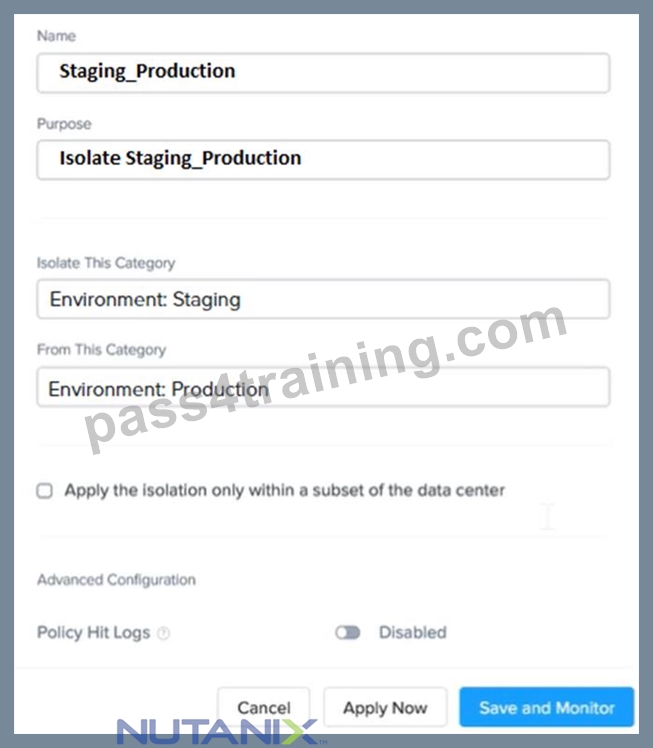
An administrator has environment that will soon be upgraded to 6.5. In the meantime, they need to implement log and apply a security policy named Staging_Production, such that not VM in the Staging Environment can communicate with any VM in the production Environment, Configure the environment to satisfy this requirement.
Note: All other configurations not indicated must be left at their default values.
Answer:
Explanation:
See the Explanation for step by step solution
Explanation:
To configure the environment to satisfy the requirement of implementing a security policy named Staging_Production, such that no VM in the Staging Environment can communicate with any VM in the production Environment, you need to do the following steps:
Log in to Prism Central and go to Network > Security Policies > Create Security Policy. Enter Staging_Production as the name of the security policy and select Cluster A as the cluster.
In the Scope section, select VMs as the entity type and add the VMs that belong to the Staging Environment and the Production Environment as the entities. You can use tags or categories to filter the VMs based on their environment.
In the Rules section, create a new rule with the following settings:
Direction: Bidirectional
Protocol: Any
Source: Staging Environment
Destination: Production Environment
Action: Deny
Save the security policy and apply it to the cluster.
This will create a security policy that will block any traffic between the VMs in the Staging Environment and the VMs in the Production Environment. You can verify that the security policy is working by trying to ping or access any VM in the Production Environment from any VM in the Staging Environment, or vice vers a. You should not be able to do so.


NEW QUESTION # 16
......
If you want to get some achievement in the IT field Nutanix certifications will be a stepping-stone. In fact high senior positions have a large demand. NCM-MCI new test copyright will pave the way for you to clear exam and obtain a certification. If you are an experienced IT test engine, owing one certification under the help of NCM-MCI new test copyright will improve your value; companies may have more cooperation opportunities.
New NCM-MCI Test Labs: https://www.pass4training.com/NCM-MCI-pass-exam-training.html
- NCM-MCI Latest Exam Experience ???? NCM-MCI Certification Exam Infor ???? Reliable NCM-MCI Study Plan ???? Copy URL 【 www.validtorrent.com 】 open and search for 《 NCM-MCI 》 to download for free ????NCM-MCI Test Pattern
- Explore Nutanix NCM-MCI Exam Questions with Our Free Demo Download ???? Enter ➥ www.pdfvce.com ???? and search for ⮆ NCM-MCI ⮄ to download for free ????Minimum NCM-MCI Pass Score
- 100% Pass 2026 Nutanix Perfect NCM-MCI: Latest Nutanix Certified Master - Multicloud Infrastructure v6.10 Exam Format ⚗ Search on ⏩ www.vce4dumps.com ⏪ for 「 NCM-MCI 」 to obtain exam materials for free download ????NCM-MCI Latest Exam Experience
- Latest NCM-MCI Exam Vce ???? Valid Study NCM-MCI Questions ???? NCM-MCI Test Pattern ???? Search for “ NCM-MCI ” and download it for free on ▛ www.pdfvce.com ▟ website ????NCM-MCI Reliable Test Practice
- NCM-MCI Exam Tutorials ???? New NCM-MCI Test Topics ???? NCM-MCI Test Pattern ???? Search for ▶ NCM-MCI ◀ and obtain a free download on ▛ www.practicevce.com ▟ ????New NCM-MCI Test Topics
- Explore Nutanix NCM-MCI Exam Questions with Our Free Demo Download ???? Download { NCM-MCI } for free by simply entering [ www.pdfvce.com ] website ????NCM-MCI Exam Prep
- 2026 Latest NCM-MCI Exam Format | High Pass-Rate NCM-MCI 100% Free New Test Labs ???? Open website ✔ www.prep4sures.top ️✔️ and search for “ NCM-MCI ” for free download ????NCM-MCI Valid Exam copyright
- Valid Study NCM-MCI Questions ???? Most NCM-MCI Reliable Questions ⚽ NCM-MCI Certification Exam Infor ⚒ Search on ▷ www.pdfvce.com ◁ for ➽ NCM-MCI ???? to obtain exam materials for free download ????Printable NCM-MCI PDF
- The Best Accurate Latest NCM-MCI Exam Format to Obtain Nutanix Certification ???? Search for ▶ NCM-MCI ◀ and download exam materials for free through ✔ www.practicevce.com ️✔️ ????Reliable NCM-MCI Study Plan
- Minimum NCM-MCI Pass Score ???? Answers NCM-MCI Real Questions ???? NCM-MCI Test Pattern ???? 「 www.pdfvce.com 」 is best website to obtain ▶ NCM-MCI ◀ for free download ????NCM-MCI Certification Exam Infor
- Latest NCM-MCI Exam Format | 100% Free Authoritative New Nutanix Certified Master - Multicloud Infrastructure v6.10 Test Labs ???? 《 www.examdiscuss.com 》 is best website to obtain ➤ NCM-MCI ⮘ for free download ????NCM-MCI Certification Exam Infor
- www.stes.tyc.edu.tw, asiyaznuv304263.law-wiki.com, steveespr631224.wikifordummies.com, classifylist.com, siambookmark.com, cecilymaog169660.wikitron.com, steveqcni568307.blogsvirals.com, peakbookmarks.com, cormachsud493533.blogars.com, bookmarkindexing.com, Disposable vapes
BTW, DOWNLOAD part of Pass4training NCM-MCI dumps from Cloud Storage: https://drive.google.com/open?id=1t_1IZNDXR_tcVzmiPBwoC1imzKdPVywU
Report this wiki page